Louise Wise (also writes as T E Kessler): womens fiction
Showing posts with label womens fiction. Show all posts

Thursday, 21 March 2019

Five ways of kicking writers' block in the arse! by Rachel Burton .@bookish_yogi @rararesources #womensfiction #romance #books #writersblock


Writers' Block?
Five steps to beat it!
by
Rachel Burton

It happens to us all in the end - we reach an impasse and the words just won't come. It can happen out of the blue. One day our stories can be flowing beautifully and the next day nothing happens. We can sit in front of our laptops all day and all we end up doing is moving a comma. And then putting it back again.


Writer’s block happens to us all and it can come from anywhere. It could be technical - we're not sure how to get from this point to the next point in the action, it could be reluctance - we're really dreading writing this chapter for some reason or other, or it could be completely non-writing related - other stresses in my life have often caused writers' block in some way or another. I've started to see it as a normal part of the creative process, we can't be on top form every single day. But, at the same time, if we don't get on top of our blocks quickly they can last for a long time and they can be hard to get 
over at all.


Here are my top five ways of kicking writers' block in the arse!


1.     Skip Ahead - You don't have to write the whole story in order. Sometimes there will be a chapter that you're reluctant to write, or that needs more research before you can do it justice. Sometimes you will realise that you don't know how to take the story smoothly from A to B but that's OK. Don't panic! Just skip ahead for a while and write a chapter that you want to write, or that you are clear on. I tend to leave a note on the part that I'm skipping - just a sentence or two in bold to remind me what I think needs to happen or what I think I need to research and then I move on. I often find that as I write another chapter (or sometimes writing the end helps too), I realise where I'd gone wrong in the bit I skipped and everything becomes clearer.


2.     Write Character CVs - If you need a bit of a break from the action of your story but don't really want to take any time out of that particular world then it might be time to really get to know your characters instead. I really love writing character CVs to help with this. I list out each characters’ eye and hair colour, favourite clothes, food and drinks. I write about their previous jobs, if they went to university, where they studied. I think about their families and their exes and I wonder about what they were like as children. None of this detail will end up the book of course, but you just might find, as you get to know your characters better, that they will help you to understand where you story needs to go.


3.     Write something else - Put your WIP to one side and write a short story (if you're still feeling reluctant to leave the world of your WIP it could be about one of your minor characters), a poem or a hiaku. Get a notebook out and journal your writing block frustrations. Start planning out that next book that's already niggling the back of your mind.


4.     Leave your desk - Go for a walk, do some yoga, go for a swim, have a bath, meditate, do some housework. Do something else that isn't writing related at all and lets your mind slip down a gear and relax a little. Sometimes we can let ourselves feel way too guilty about not writing but I believe that sitting down in front of your laptop is just part of the writing process. We need to allow our minds to have time away from churning out the words and be free to daydream because often that's where the lightbulb moments of writing happen. I came up with the plot for my fourth book while cleaning out the shower drain!


5.     Nap - If all else fails, kick guilt in the arse and take yourself off to bed. I'm always amazed by the clarity I have about a problem when I sleep on it (and that applies to non-writing things as well!)

If you try all these things and you're still blocked, your story still isn't going anywhere and you're still blocked it might be time to ask yourself if you're writing the story you want to tell. Sometimes a book idea might not work and that's OK. Sometimes we might have been writing a story for the wrong reasons, and that's OK too. Sometimes the story might be right but you've set it in the wrong place, or you're telling it from the wrong point of view (more on POVs in a week or so).


Know when it's time to let an idea go and start again. The first draft of my second book was set in the wrong place and told from the wrong point of view. I struggled on even when I knew it wasn't working - but then rewrote it anyway. If I'd gone with my intuition I'd have saved myself time and heartache!


The Pieces of You and Me

by

Rachel Burton

They say time can heal all wounds…

When Jess and Rupert parted ways, it was the end of a great love story that might have been. Now ten years later, the very different paths they have taken in life will bring them back together for a chance meeting.

Purchase Link
But with so much left unsaid about the break up neither ever recovered from and with each keeping their own devastating secrets, will they finally be able to make the fractured pieces of their love for one another whole again?
 About Author Rachel Burton


Rachel Burton is the author of the international ebook bestseller The Many Colours of Us. 

Rachel spent most of her life between Cambridge and London but now lives in Yorkshire with her fiance and their three cats. The main loves of her life are The Beatles and very tall romantic heroes.

Find her on Twitter & Instagram as @bookish_yogi or follow her blog at rachelburtonwrites.com. She is always happy to talk books, writing, music, cats and how the weather in Yorkshire is rubbish. She is mostly dreaming of her next holiday....


Friday, 6 July 2018

Historical coming of age fiction! An explorer and a downtrodden circus acrobat in a hot air balloon in search of an artifact have an adventure of a lifetime! #historical #books #fantasy #raiders

Research can be taken from real-life situation!
by
Patrick Canning


The word ‘research’ probably conjures up images of dusty library archives, meticulously sourced bibliographies, and maybe even microfiche (if you’re of a certain age). But research for The Colonel and the Bee was some of the most fun I’ve had in writing a book.

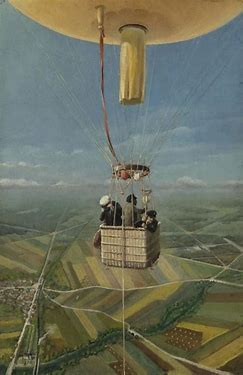
Once I had my idea: a destitute acrobat and a flower-obsessed adventurer explore the world of the early 19th Century in a fantastically large hot air balloon, I needed some help filling in the details. The story wouldn’t be beholden to reality at every turn, but I’ve always thought a measure of science makes even the most outlandish fantasy that much better. It was time to do some research.

While I admit going to the Wikipedia well more than I should, I quickly found many other amazing sources of information. Ballooning by C. H. Gibbs-Smith, an antiquated look at the world of hot air ballooning before 1946, provided some great aeronautical theory and history of ballooning. In an ill-visited corner of the upper floor of The Last Bookstore in Downtown Los Angeles (a great place to check out if you’re ever in LA), I discovered Forty Favorite Flowers by Beverly Nichols, a 1970s guide to curious flowers and how they fare in an English garden. Aside from having a great old book smell, Forty Favorite Flowers helped bring the Colonel’s extensive horticultural knowledge into focus. A dictionary of Victorian slang delivered gems like “enthuzimuzzy” (much ado about nothing) and “butter upon bacon” (excessive extravagance), but it was Lina Rivera, The Colonel and the Bee’s editor, who contributed what is probably my favorite bit of Victorian wordage: “chuckaboo” (friend).

By far the most thrilling and enjoyable bit of research was a trip in a real hot air balloon. I took note of all the sensations and emotions that came with the unique way of flying, and paid close attention to the charismatic British pilot’s manner of speaking (“The crown line’s in a bit of a state!” and “A woman can understand a compliment in any language, can’t they?”). The difficulty in controlling a craft as unwieldy as a hot air balloon was made clear with our unscheduled landing on a golf course. Luckily, the irate owner was placated with a handy bottle of champagne.

Imagination might do most of the leg work when it comes to fiction, but I hope all these real-world details help further color the world Beatrix and the Colonel explore, and make for a more engaging and exciting read.

Introducing...
The Colonel and the Bee
Beatrix, a spirited but abused acrobat in a traveling circus, seeks more than her prison-like employment offers. More than anything, she wants to know her place in the world of the halcyon 19th century, a time when the last dark corners of the map were being sketched out and travel still possessed a kind of magic.


Amazon

One night in Switzerland, the mysterious Colonel James Bacchus attends Beatrix’s show. This larger-than-life English gentleman, reputed to have a voracious appetite for female conquests, is most notable for traveling the world in a four-story hot air balloon called The Ox.

Beatrix flees that night to join the Colonel, and the two of them make a narrow escape—Beatrix from her abusive ringleader, the Colonel from a freshly-made cuckold. Beatrix, feeling the Colonel may have the answers to her problems, pledges to help him catch the criminal he seeks in exchange for passage on his magnificent balloon.

The criminal seeks a precious figurine, The Blue Star Sphinx, but he’s not alone. The Sphinx’s immense value has also drawn the attention of the world’s most deadly treasure hunters. A murder in Antwerp begins a path of mystery that leads all the way to the most isolated island on Earth.


Patrick Canning spends as much time as possible turning coffee into collections of words that look like books, shorts, and screenplays.

Most of his stories attempt to look for the meaning of life in an adventurous way, and often employ humor, important since the search usually doesn’t turn up much. He lives in Los Angeles with his dog, Hank.


An extract from The Colonel and the Bee

“Flying the Ox is much more akin to playing an instrument than operating a machine. Approach the challenge less formally, do so with confidence, and the craft’s perfect obedience will be your reward.”

I lost sight of the burner strap and by accident pulled a vent on the main balloon. We began to rotate and descend with great rapidity. The Colonel allowed me to find the correct cord on my own, and I did so just in time as the Ox nearly scraped a rolling pasture hill, startling a herd of brown Belgian cows enough to sour their milk.

Taking care to avoid the ripping line, I continued to bring the Ox up, searching for the northwest wind. To my chagrin, I sent us southeast, and it took a deft intervention from the Colonel to set us right. Applying the correct pressure on the correct combination of cords in the correct sequence did indeed give him the appearance of an accomplished maestro.

“Skill comes with practice, and northwest can be elusive. Northeast can be downright tempestuous,” he said as if recalling a talented snooker rival.

I readied another question, but the Colonel anticipated me. He held up a gentle hand to stay the incoming query, motioned with both hands downward, indicating I should relax, then gestured to the edge of the Ox.

So worried I’d been about that morning’s lesson, I’d hardly taken a moment to observe our environment. I joined the Colonel at the railing, and became lightheaded with wonder. The full effect of flight had been disguised by darkness the previous night, and now, in the maturing light of dawn, I beheld a world transformed by perspective: rivers and mountains were maps come to life, trees were seas of leaves that shimmered emerald in the breeze, even birds flew at a height far below the Ox, moving like schools of fish in currents of wind.

“Toast my bloomin’ eyebrows,” I mumbled, forgoing any attempt at eloquence. “I didn’t know... I couldn’t have imagined...”

“Wonderful, isn’t it? From this height, we’re permitted to see plainly the orchestrations of daily life, rank with crisscrossing motives and the clutter of needless haste. Up here in the rarefied air we are weightless in cool æther, unspoiled by the odour and noise of man’s desires far below.”

We stood side by side, watching the scene in silence, until something in the distance stole the Colonel’s gaze.

“There. Antwerp on the horizon. Drink your leaf juice if you must.”

By now, all of the Manx were flying in a loose halo about the Ox, gently displacing the Belgian mist we floated in as they dove and twisted as birds in play.

“They have such charm and spirit,” I said.

“They detect my excitement. This visit could prove fruitful in our search for the criminal. He’s been most elusive thus far.”

“Do you know the murdered party?”

The Colonel’s face fell a note, but he recovered quickly.

“I’m interested in the criminal.”

“To bring him to justice?” I gulped my tea. “For this or a past transgression?”

“There is plenty to choose from. It is enough for you to know I seek an audience with the man.”

“He has committed other crimes?”

“Certainly.”

“Is he dangerous?”

Most certainly.”

I finished my tea as the green vegetation and black soil of tilled fields shifted to the red brick and grey stone of buildings. Antwerp’s harbour introduced itself to the nose long before the eyes.

The Colonel inhaled deeply.

“Have you been?” he asked.

I shook my head.

“A bastion of crime and seafood, how I adore this city. I apologise as it’s unlikely we’ll have time for a proper tour. Perhaps a return under less harried circumstances. Unfurl those ropes there, won’t you?”

The spiderweb of roadways below passed ever faster as we descended. I let drop a collection of heavy ropes over the side of the Ox as the Colonel set her down in a rather regal park. Despite the posh surroundings, there was an air of danger. Apparently, the Colonel felt it too.

“No chance we’re deflating here,” he said. “Down the steps with you. Help secure us.”

Wednesday, 21 March 2018

To ensure a successful book signing event in 10 steps! @rararesources @schristodoulou2 #literature #historical

Book Signing in 10 steps!


by
Soulla Christodoulou


Thank you for inviting me to contribute to your theme of ‘how to and tips of the writing trade’. I thought since I’ve been planning my first ever book signing event for The Summer Will Come I would share with you my plans for ensuring its success in 10 simple steps.

1.     The first thing I did was set a realistic date for the launch and release of the book. I thought carefully about how long I would need to do any beta reader corrections, get the book formatted and ready for release. In my case I have chosen the 25th March as it is the start of British Summer time and the timing fits in with the title of my book because the summer is on its way and so The Summer Will Come is perfect in so many ways!

2.     Once I had set the date I had to choose the venue to hold the launch. I wanted to choose a venue that was local, had parking, was not too big and which would be able to meet my requirements for offering food and drink. I have chosen a lovely little coffee shop which is run by a local Greek Cypriot woman.

3.     I confirmed the venue and timings with her. I confirmed what she was able to provide and support me with and how many people the coffee shop- would hold comfortably – combination of sitting and standing.

4.     List of guests – I began putting a guest list together and started with my nearest and dearest and worked my way out – family, friends, work colleagues, authors I knew, other writers, local press. I have since added names to the list as they come to me, so the list is organic and growing.

5.     The invitation and spreading the word – I designed the invitation using a blank book cover to keep the theme of the book. I included all the basic information but added that only cash sales would be made so people buying the book do not arrive with no cash on them. I have asked for an RSVP so that I can judge how many guests to expect on the day – this will inform my food requirements and number of books needed on the day for sales. I have sent this out across a number of different platforms including social media, SMS, What’s App, etc.

6.     Plan for the day – If people are going to make the effort to come to my book launch I too would like to make it interesting and fun for them. I have organised a book reading, a time for book signing, a Q and A which will give my guests the opportunity to ask me something about my writing and the book and of course some Greek Cypriot hospitality by offering complimentary food and refreshments. I have also ordered a puzzle of the front cover with an idea for a game as guests arrive!

7.     My A team – I realised that trying to organise every aspect of the party would be too much for me. So I rallied a number of people to help me with advance planning and of course help on the day. My sister is baking a cake and topping it with a cake topper of my book cover, my mum is baking some Greek Cypriot savouries, an aunt is making some cookies, my mum is making bunting in colours to co-ordinate with the book cover… I have organised someone to take photographs, someone to do the books sales (and organised a float for them), my cousin who is a florist is making floral table arrangements for me.

8.     Props and timings – I’ve had posters of my book cover printed, bunting, cake with book cover cake topper, flowers, mini framed book covers to have around the coffee shop and of Greek finger nibbles and refreshments and Greek music! I’ve also got bits mentioned in the book like the ticking clock, the red eggs, the little Bible, the Lefkaritika (lace) and the tsestos (flat woven basket) to make a table display. It’s about making it ‘real’ for the guests and creating a little bit of The Summer Will Come at the party.

9.     Plan my engagement with my guests – I will welcome them all personally as they arrive, I have chosen my extracts, have drawn up a list of who to thank, I’ve printed the poem from which I chose the title of my book so I can read it out.

10.  Book supply and gifts – I have organised some giveaways too which link to scenes and characters in the book – and a supply paperback copies based on RSVPs received for signing!


I hope you have found this useful! All that’s left to be had now is to have some fun! Enjoy the day and celebrate with my friends and family around me and of course, thank you too for your wonderful support. I wish all of you, too, lots of luck in what you are doing.


Introducing...

The Summer Will Come

Set in 1950s Cyprus, EOKA, British rule, the fight for Enosis (unity) with Greece and two Cypriot families, living in different villages on the island, are coping with the unpredictability of this fractious time. 
Amazon

Circumstances over a five year period push both families to emigrate to London where, as immigrants, they struggle to settle, face new challenges, trauma and cope with missing  their homeland's traditions and culture.

Both families' lives cross paths in London and it seems that happier beginnings could be theirs. But at what cost?
A story of passion for a country in turmoil, family love, loyalty and treachery.

~~~
Born in London to Greek Cypriot parents Soulla Christodoulou spent much of her childhood living carefree days full of family, school and friends. She was the first in her family to go to university and studied BA Hotel and Catering Management at Portsmouth University. Years later, after having a family of her own she studied again at Middlesex University and has a PGCE in Business Studies and an MA in Education.

Soulla is a Fiction author and wrote her first novel Broken Pieces of Tomorrow over a few months while working full time in secondary education and is a mother of three boys.
She is a compassionate and empathetic supporter of young people. Her passion for teaching continues through private tuition of English Language and Children’s Creative Writing Classes. She offers writing services too in support of businesses, authors and students.

Her writing has also connected her with a charity in California which she is very much involved in as a contributor of handwritten letters every month to support and give hope to women diagnosed with breast cancer. One of her letters is featured in a book ‘Dear Friend’, released on Amazon in September 2017.

When asked, she will tell you she has always, somewhere on a subconscious level, wanted to write and her life’s experiences both personal and professional have played a huge part in bringing her to where she was always meant to be; writing books and drinking lots of cinnamon and clove tea!

She also has a poetry collection inspired by old phrases and sayings, Sunshine after Rain, published on Amazon and is releasing her second novel, The Summer Will Come in March 2018.
She is currently working on a third novel, Trust is a Big Word, about an on-line friendship which evolves over time into an illicit cyber relationship.